Goosky S2 reviewed: the 200-class that grew up
Bigger, calmer and more capable than the S1 that made Goosky's name. After a season of flying, here is whether the S2 is the right first collective-pitch for a UK club pilot.
The Goosky S1 rewrote the bottom of the collective-pitch market — see our year-on S1 review. The S2 is what Goosky did next: a larger, heavier, more planted 200-class machine aimed at the pilot who has learned to hover and wants a helicopter to grow into rather than out of. We have flown three of them across a UK spring and summer season. Here is how it holds up.
The headline specs
- Class: 200-size collective pitch
- Rotor diameter: 460mm
- Flying weight: ~780g with 3S 1300mAh pack
- Battery: 3S 1100–1500mAh LiPo
- Motor: 3100kV brushless
- Headspeed: ~2,500 RPM hover
- Flight controller: Goosky GFB (GFB-Pro available)
- Versions: BNF with Spektrum DSMX, FrSky, or FlySky receiver options
- Street price: ~£420 BNF
Out of the box
The S2 ships assembled in a compact box with two main blade sets, a tail blade set, an M2 hardware bag and a bind plug. Build quality is a clear step above budget machines and comparable to the class-leading OMP M2 Explorer: carbon-fibre frame, metal rotor head, a properly engineered swashplate. The cable routing in particular is tidy — Goosky run the ESC and servo wiring through the frame cleanly, with noticeably less loose zip-tie and heat-shrink than most competitors.
Setup follows the standard collective-pitch routine: bind the receiver, set throttle hold, confirm swashplate type (120° CCPM), check servo directions, load the factory gyro gain, and spool up. If any of that is new, our transmitter setup guide and pitch and throttle curve guide cover it. Most owners are flying within half an hour.
Flight characteristics
The S2's defining quality is that it is calmer than the S1. The extra 260g of flying weight and the larger 460mm disc make it markedly more planted in wind — where the little S1 gets shoved around above 8mph, the S2 shrugs off the same breeze and stays workable. For UK club flying, where a genuinely still day is rare, that is the single most important difference.
Hover stability is excellent. The tail holds firmly in light-to-moderate wind, altitude is rock-steady, and the machine sits in the air with an authority the S1 never quite had. This is a helicopter you can teach yourself to hover on and then keep for years.
Cyclic response in the default profile is slightly more aggressive than the M2 Explorer — it reaches its 3D envelope with a touch less stick deflection, which pilots who want to progress into aerobatics will like. It is still perfectly controllable for a pilot stepping up from a coaxial or the under-£150 trainers.
3D capability is genuine. Inverted flight, loops, rolls, tic-tocs and piro flips are all within the airframe's ability. It is not a dedicated competition machine, but the ceiling comfortably exceeds where most pilots ever reach — you will not outgrow the S2 in your first two years.
Forward flight is where the size pays off again. At cruise the S2 feels solid and tracks cleanly, making the scale-style passes and flybys that the S1 was really too light for.
Battery and runtime
A 3S 1300mAh pack gives about 5–6 minutes of mixed flying; a 1500mAh nudges past 6. Packs are cheap (£15–£20) and light, and a six-port parallel charger refills four in half an hour at 1C. Four to six packs makes a full field session. For choosing and caring for them, see choosing LiPo batteries.
The GFB flight controller
The standard GFB unit is well-tuned out of the box and configurable over Bluetooth. It is functional and reliable; the app is a little less polished than OMP's, with slightly terser parameter explanations. For a pilot who sets the helicopter up once and leaves it, this makes no difference. For a tinkerer who wants to iterate on pitch curves and gyro gains, OMP's app is the friendlier tool.
The GFB-Pro upgrade adds GPS-assisted position and altitude hold — useful insurance for a newer pilot, and worth the premium if your flying sites are exposed. It does not turn the S2 into a self-flying drone, but it will hold position while you gather your nerves.
What to watch out for
Three notes from sustained use:
- Check blade tracking before the first flight. One of our three units needed a minor tracking tweak out of the box. Standard for any new heli — see tracking your blades — not a fault.
- The default headspeed suits hovering, not hard 3D. Pilots pushing into aggressive aerobatics will want to raise it in the flight-controller profile.
- Thread-lock the tail. As on every helicopter, the tail vibrates most; untreated screws back out. If you get tail wag, our tail wag diagnosis guide sorts it, and tail rotor replacement covers the mechanical fix.
S2 vs S1 vs M2
- vs the S1: the S2 is the better choice for anyone flying primarily outdoors at a club. The S1 remains the pick if you want the smallest, cheapest, most indoor-friendly collective pitch and you fly in calm conditions. The S2 is the one you keep longer.
- vs the OMP M2 Explorer: genuinely close. Fly a Spektrum radio and want SRXL2 telemetry and the more polished tuning app — the M2. Want the tidier airframe, slightly punchier 3D feel, marginally lower price and widest UK parts availability — the S2. The full breakdown is in our M2 vs S2 comparison.
Who it is for
The S2 is the right helicopter for the pilot who has learned to hover on a coaxial or small trainer and wants one collective-pitch machine to carry them from first proper flights through to competent 3D and scale-style flying, at a UK club, in real weather. It is stable enough to learn on, capable enough to grow into, and well enough supported to keep flying for years.
It is not the right pick for someone wanting the absolute smallest indoor machine (stay S1), a dedicated competition 3D platform (look higher up the class ladder), or a first-ever aircraft to learn hovering from scratch on — start smaller and cheaper first, as our first helicopter guide explains.
Verdict
The Goosky S2 is one of the two best 200-class collective-pitch helicopters on the UK market in 2026. It takes everything that made the S1 a landmark machine and adds the weight, stability and capability that the S1 lacked for serious outdoor club flying. For most pilots moving up from a trainer, it is a helicopter to buy once and fly for a long time. Recommended without reservation — with the OMP M2 Explorer as its only genuine rival, and Spektrum-radio ownership the main reason to choose the M2 instead.
Kit to build what you just read
All helicopters →
Keep reading · Reviews
The best scale RC helicopters under £1,000 (2026)
You don't need to spend four figures for a genuine scale helicopter. Here are the best ready-to-fly scale ships under £1,000 — from £449 Flywings to Roban's 450-class RTF range.
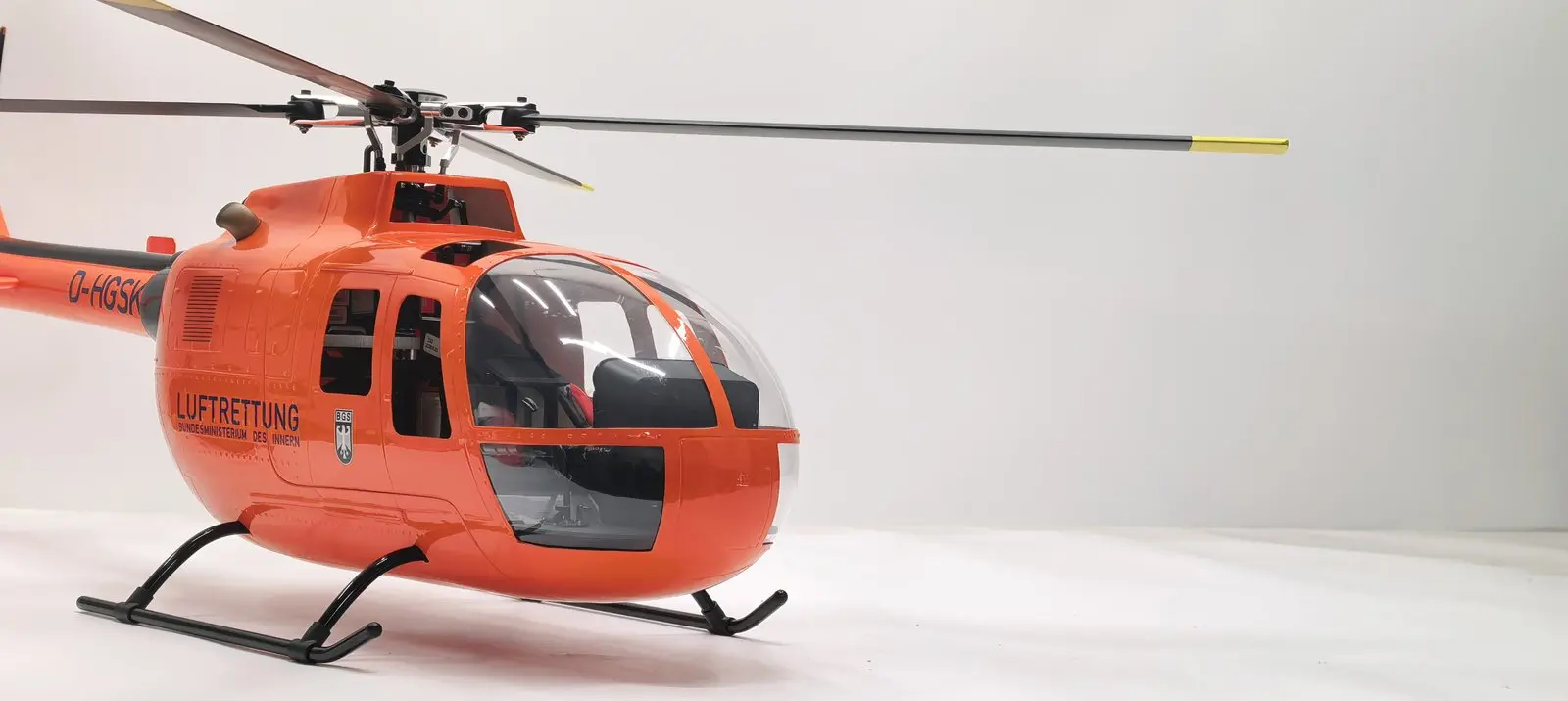
FLISHRC BO105 in orange reviewed: the air-ambulance that flies itself into a hover
The MBB Bölkow Orange 'Luftrettung' livery on the 500-class FL500 V2 platform. Four-blade scale head, GPS-locked hover, £1,600 — and the prettiest of the BO105 range. Here is how it flies.
Best RC helicopters under £150: beginner shortlist 2026
Coaxials, small fixed-pitch trainers, and one collective-pitch surprise. Six helicopters under £150 that are actually worth buying as a first machine.