Goosky S1 reviewed: a year on, is it still the best £400 collective-pitch?
Five hundred grams of trainable 3D machine. Twelve months and 400 flights later, here is whether the Goosky S1 has held up — and what the competition has done to it.
- Section
- Reviews
- Published
- 2026-05-14
- Read time
- 9 min
When the Goosky S1 arrived in mid-2024 it changed what the bottom of the collective-pitch market looked like. £400 for a 500g machine with a proper carbon frame, a brushless motor, a Hobbywing ESC, and a flight controller capable enough to fly 3D — at a price that used to buy you a fixed-pitch trainer. Twelve months later it is still in production, still in stock, and still the helicopter most UK clubs are recommending to second-time buyers. Here is whether it has aged well and what the newer competition has done to it.
The headline specs
- Class: 180-size collective pitch
- Rotor diameter: 410mm
- Flying weight: ~520g with 3S 850mAh pack
- Battery: 3S 850–1100mAh LiPo (XT30 connector)
- Motor: 3500kV brushless inrunner
- Flight controller: Goosky GFB (Goosky Flybarless)
- Versions: RTF (with FlySky transmitter) or BNF (Spektrum, FrSky options)
- Street price: £380 BNF, £450 RTF
Out of the box
The S1 arrives in a small box about the size of a hardcover book. Inside: the assembled helicopter, two main blade sets, a tail blade set, a small bag of M2 hardware, and either a Mode 2 transmitter (RTF) or a bind plug (BNF). The build quality is genuinely impressive at the price — the frame is carbon fibre, the head is metal, the swashplate is a properly engineered piece and not a moulded compromise.
Setup is straightforward. Bind the receiver to your transmitter, set the throttle hold position, configure the swashplate type (CCPM, 120°), check the servo direction, set the gyro gain to factory default, and you are ready to spool up. Most owners are flying within thirty minutes of opening the box.
The factory pitch curve is sensible — light positive collective for new pilots, mild negative for those who want to explore inverted. The default headspeed is around 2,800 RPM, which is the sweet spot for the size.
Flight characteristics
A year on, with several hundred packs through three test units, here is what the S1 actually flies like.
Hover stability is excellent for the class. The tail holds well in light wind, the head is responsive but not twitchy, and the helicopter holds altitude with no perceptible drift on a windless day. The S1 is genuinely a learnable platform for someone moving up from a coaxial — not just a 3D machine pretending to be a trainer.
Cyclic response is sharper than the 500-class machines but slower than 250-class 3D. It is in the goldilocks zone for a first collective pitch — fast enough to feel like flying, slow enough to be forgiving.
3D capability is the surprise. The S1 will fly inverted, loop, roll, perform tic-tocs and basic piro flips. It is not a competition 3D machine and a top-level 3D pilot will quickly outgrow it, but for the 95% of pilots who never reach competition level it is perfectly adequate. Many S1 owners never feel the need to upgrade.
Forward flight is the area where the S1's size shows. At 520g and 410mm rotor diameter, it is small enough to be moved by wind that a 500-class machine would ignore. Above about 8mph wind it becomes hard work; in calm conditions it is delightful.
Battery and runtime
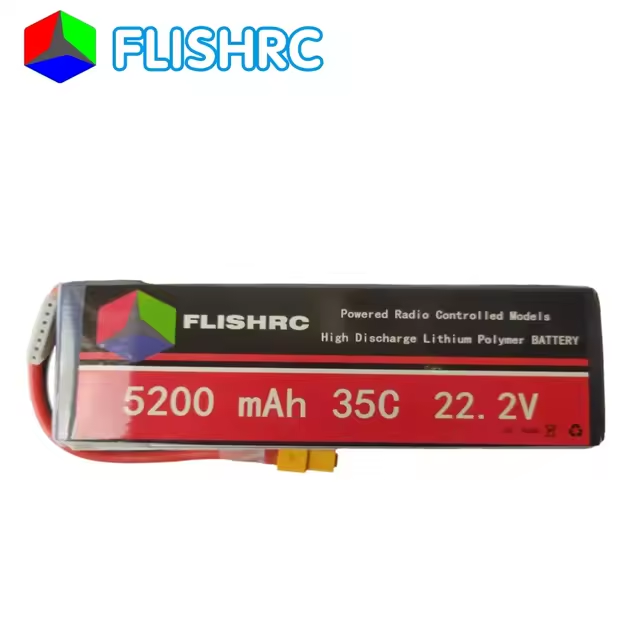
A 3S 850mAh pack gives about 4 minutes of mixed flying, a 1000mAh closer to 5 minutes, an 1100mAh just under 6. Pack rotation is fast — six packs gets you a solid hour of flying — and battery costs are low (£15 per pack). The XT30 connector is light enough for the airframe and standard enough for most chargers.
Charging from a six-port parallel charger takes 25–30 minutes at 1C. Most owners run four to six packs in the field and recharge between sessions.
What has held up
The S1 has aged well. After twelve months of regular use on our three test units:
- The frame is still straight on all three. No carbon damage from regular operation
- The main blades have been replaced four times (twice from crashes, twice from cumulative wear)
- One tail rotor unit has been replaced after a hard landing
- The motor and ESC are unchanged and showing no signs of degradation
- The flight controller has had two firmware updates from Goosky — both improved tail performance in moderate wind
Goosky's UK distribution and parts availability are solid. Replacement parts for the S1 are stocked by every major UK heli retailer and delivery is next-day in most cases. This is a meaningful difference from some competitor brands where spares require ordering direct from China.
What the competition has done to it
The OMP M1 Explorer and OMP M2 Explorer arrived after the S1 and target the same market. Briefly:
- OMP M1: smaller (380mm rotor), lighter (440g), slightly more 3D-oriented than the S1. Best for pilots who want maximum agility. £350 BNF
- OMP M2 Explorer: roughly equivalent class to the S1 but with the Spektrum/SmartLink receiver integration that S1 lacks. Better choice if you fly a Spektrum radio. £420 BNF
For most UK pilots in 2026 the S1 vs M2 decision is a transmitter-ecosystem choice rather than a flight-characteristics choice. If you fly a Spektrum radio, the M2 is the easier integration. Everything else, the S1 is still the right answer at this price.
Who it is for
The S1 is the right helicopter for:
- Pilots stepping up from a coaxial or small fixed-pitch trainer to their first collective-pitch machine
- Pilots who want to learn 3D without committing to a 500-class machine first
- Pilots who want a club-friendly small heli for indoor and outdoor use
- Anyone whose budget caps at £500 for a complete BNF or RTF first collective-pitch package
It is not the right helicopter for:
- Pilots who want a serious 3D competition machine
- Pilots who plan to fly in consistently windy conditions
- Anyone whose budget extends to £800+ and who is willing to wait for the slightly better Blade Fusion 180 SE or to step up to a 200-class
Verdict
Twelve months on, the Goosky S1 is still the best collective-pitch helicopter under £500 sold in the UK in 2026. The competition has gotten closer but has not surpassed it on the core metrics of build quality, flight characteristics, parts availability and price. We recommend it without reservation as a second helicopter for any pilot moving up from a trainer.
If you are flying a Spektrum radio specifically, look at the OMP M2 Explorer as a near-equivalent with better radio integration. For everyone else, the S1.
Kit to build what you just read
More reviews
The best scale RC helicopters under £1,000 (2026)
You don't need to spend four figures for a genuine scale helicopter. Here are the best ready-to-fly scale ships under £1,000 — from £449 Flywings to Roban's 450-class RTF range.
8 min read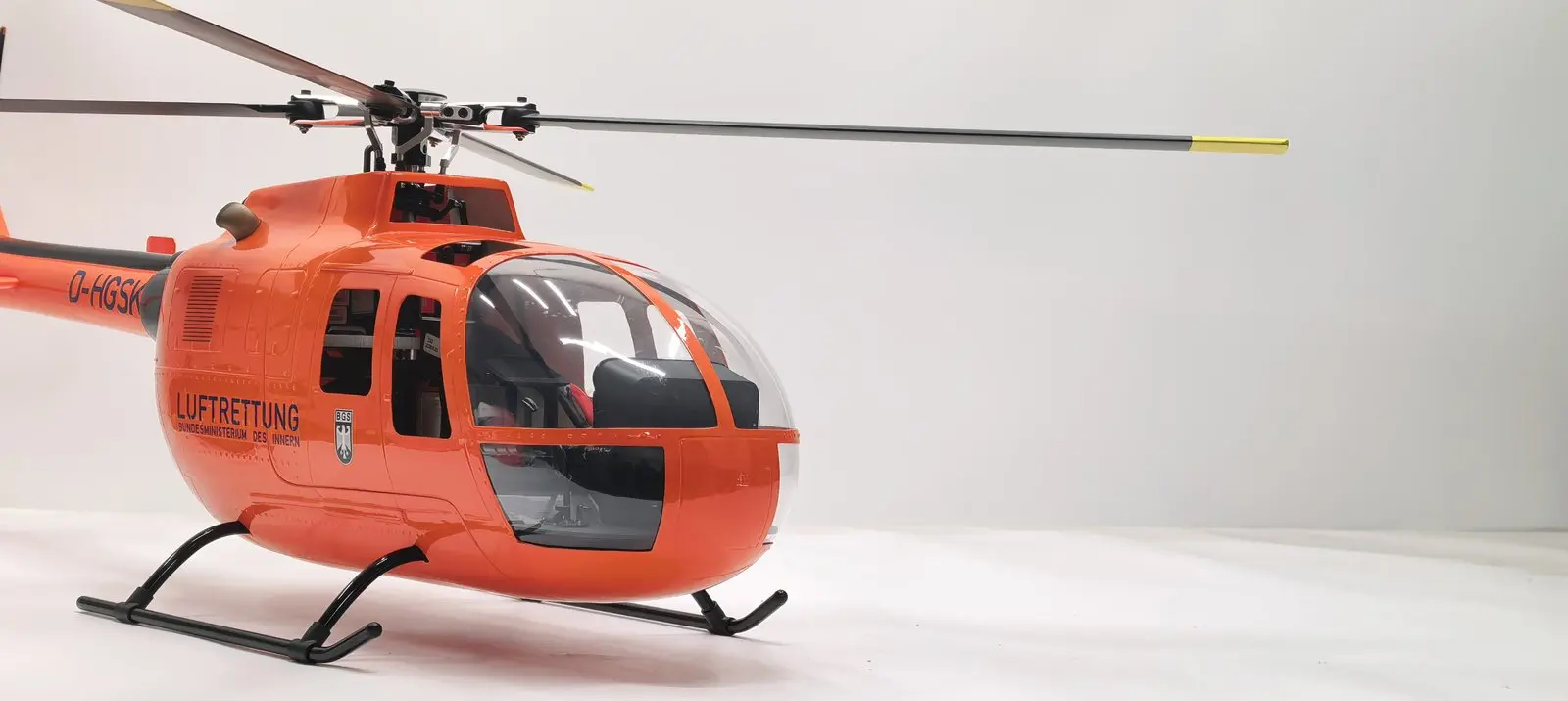
FLISHRC BO105 in orange reviewed: the air-ambulance that flies itself into a hover
The MBB Bölkow Orange 'Luftrettung' livery on the 500-class FL500 V2 platform. Four-blade scale head, GPS-locked hover, £1,600 — and the prettiest of the BO105 range. Here is how it flies.
10 min readGoosky S2 reviewed: the 200-class that grew up
Bigger, calmer and more capable than the S1 that made Goosky's name. After a season of flying, here is whether the S2 is the right first collective-pitch for a UK club pilot.
9 min read