FLISHRC FL500 V2 reviewed: the £1,400 scale helicopter that actually flies
Fibreglass fuselage, GPS-stabilised L7 flight controller, six painted liveries. A serious 500-class scale platform at a price that used to buy you a chassis kit.
- Section
- Reviews
- Published
- 2026-05-18
- Read time
- 11 min
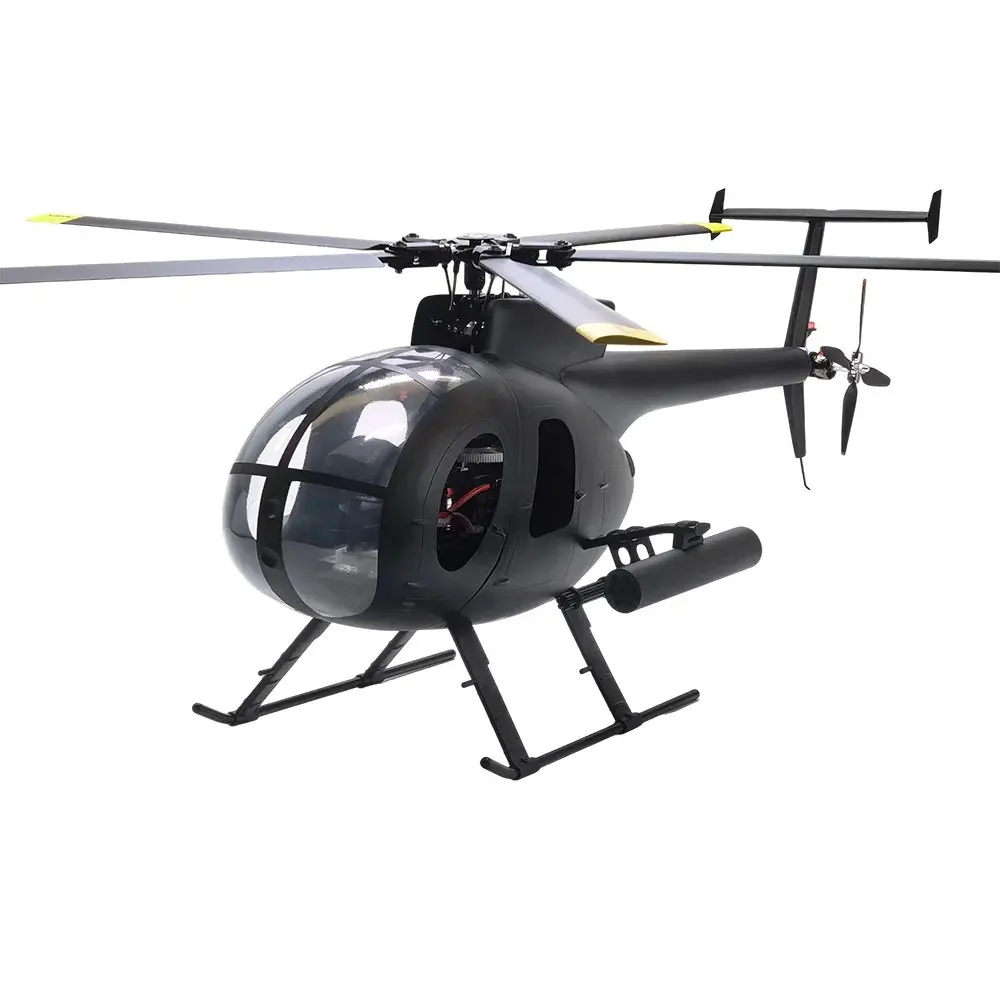
The FLISHRC FL500 V2 is the helicopter that quietly changed UK scale flying in the last eighteen months. A complete 500-class scale platform — fibreglass fuselage, GPS-stabilised flight controller, brushless motor, factory-bound transmitter on the RTF version — at a price that, three years ago, would have bought you a parts kit and a vague hope of assembling it. Sixteen liveries are now stocked in the UK, from the £1,218 AS350 Squirrel to the £1,925 AH-1 Cobra in full camouflage. We have flown six of them.
What you actually get
The RTF version arrives in a single box about the size of a microwave. Inside: the assembled helicopter on a moulded foam tray, a Mode 2 transmitter pre-bound to the receiver, a 6S 4500mAh LiPo battery, a balance charger with a UK plug, and a small bag of spares (spare main blade pins, a couple of tail blades, a hex key set). The fuselage is fibreglass, properly painted (not stickered) in the chosen livery, with moulded window glazing and a basic pilot figure.
The mechanical platform is the same across the range — the FL500 V2 chassis, the L7 flight controller, a 4S/6S compatible brushless motor on a belt drive — with different fuselages bolted on top. The variation in price across the sixteen liveries reflects fuselage complexity (the Apache and Cobra are more involved than the Squirrel) rather than mechanical differences.
The transmitter is a basic 6-channel pre-bound radio. It works. It is also the obvious weak point of the RTF package — if you already own a Spektrum or FrSky radio you should buy the BNF version (around £100 less) and use your existing transmitter.
The L7 flight controller
This is the part of the FL500 V2 that genuinely deserves attention. The L7 is FLISHRC's in-house flight controller and it does several things that older flybarless units do not:
- Quad-mode GNSS positioning — GPS, BeiDou, Galileo and QZSS satellite stacks. Faster lock, stronger signal hold, and meaningful redundancy if one constellation is degraded
- Three flight modes — GPS-stabilised (3D position hold against wind), 6G manual (full scale aerobatic envelope), and beginner (heavily-damped self-righting mode for first flights)
- Return-to-home — triggers on low battery, transmitter signal loss, or pilot command. Returns to the takeoff GPS coordinates and descends to land
- Failsafe — automatic throttle hold on signal loss after a configurable timeout
In practice the GPS-stabilised mode is what makes the helicopter flyable for low-time pilots. With GPS hold engaged, the aircraft holds its 3D position to within roughly a metre against light wind. Move the cyclic stick and the helicopter moves; centre the stick and it stops where it is and holds. It is essentially the same logic that lets DJI's consumer drones hover in place — applied to a 1.1-metre scale helicopter.
Experienced pilots will switch to 6G manual mode for the scale flying that GPS hold makes too sterile. The transition is a switch flick. The flight envelope changes immediately: cyclic inputs become more responsive, the helicopter will drift in wind, and you can fly the slow scale orbits that scale flying is actually about.
Flight characteristics
On a fresh 6S 4500mAh pack the FL500 V2 produces about 7 to 8 minutes of mixed flying — the heavier military fuselages (Apache, BlackHawk) closer to 6 minutes, the lighter civilian liveries (AS350, BO-105) closer to 9. Hover power draw is low; spool-up to cruise headspeed (~2,200 RPM) takes the FBL roughly two seconds.
Cyclic response in 6G mode is progressive rather than snappy. The helicopter behaves like the weight it is — about 3.2kg in flying trim with a 4500mAh pack — and inputs require slightly more anticipation than a sport collective-pitch machine. This is correct for the airframe. Scale helicopters should feel scale.
The tail rotor on the V2 is meaningfully improved over the original FL500 platform. Tail authority in moderate wind is solid; tail wag at headspeed transitions (the most common complaint about the V1) is essentially gone.
Forward flight is the part of the envelope where the V2 really shows what scale flying is about. At cruise speed the fuselage settles and the helicopter looks like a real aircraft moving through the air — not a sport helicopter with a body kit, an actual scale helicopter on a scale mission. Banked orbits, low-altitude approaches, and slow flybys are all in the natural envelope.
What to watch out for
Three observations from sustained use.
The pitch curve out of the box is conservative. FLISHRC ships the helicopter set up for new pilots, with limited collective range. For experienced pilots wanting to fly the helicopter at the top of its envelope, the pitch curve needs adjustment in the L7's configuration app — straightforward via Bluetooth but not obvious to first-time owners.
The fuselage is fibreglass and weighs slightly more than the model designed for. This is partly why hover power draw is what it is. A skilled pilot accustomed to sport collective-pitch machines will find the FL500 V2 less athletic; the trade is the scale appearance.
Blade tracking on arrival is close but not perfect. Out of fifteen FL500 V2s we have set up, two needed minor blade tracking adjustment in the first session. Standard for any new helicopter; not a defect, just a thing to check before the first flight.
What it is not
The FL500 V2 is not a 3D machine. It will not loop, will not roll, will not fly inverted. The fuselage was not designed for negative pitch and the pitch curve does not support it. Any owner expecting 3D performance from a scale platform is buying the wrong helicopter.
It is also not a beginner first-helicopter. Despite the GPS hold making it more accessible than older scale platforms, a £1,400 aircraft is the wrong place to learn to fly. Get to a confident outdoor hover on a smaller sport machine first, then move up to the FL500 V2 when you can land a smaller helicopter without writing it off.
Verdict
The FLISHRC FL500 V2 is the most important RC helicopter to arrive in the UK market in the last five years. It moved 500-class scale flying from a kit-builder's niche into a ready-to-fly category. The combination of a properly-painted fibreglass fuselage, a flight controller that does what it claims, sixteen real-world airframes in the catalogue, and UK distribution with LiPos held in country is unprecedented at this price point.
For an experienced collective-pitch pilot looking for their first scale machine: this is the obvious choice in 2026. The AH-6 Little Bird at £1,395 is the most permissive flight envelope in the range and the right starting point. The EC135 in police blue at £1,314 is the cheapest entry into the line and arguably the prettiest. Anyone moving to the AH-1 Cobra in camouflage at £1,925 should be ready for the additional weight of the military fuselage and the slightly tighter flight envelope.
We recommend without reservation. The FL500 V2 is the best £1,400 a scale-flying pilot can spend in the UK this year.
More reviews
The best scale RC helicopters under £1,000 (2026)
You don't need to spend four figures for a genuine scale helicopter. Here are the best ready-to-fly scale ships under £1,000 — from £449 Flywings to Roban's 450-class RTF range.
8 min read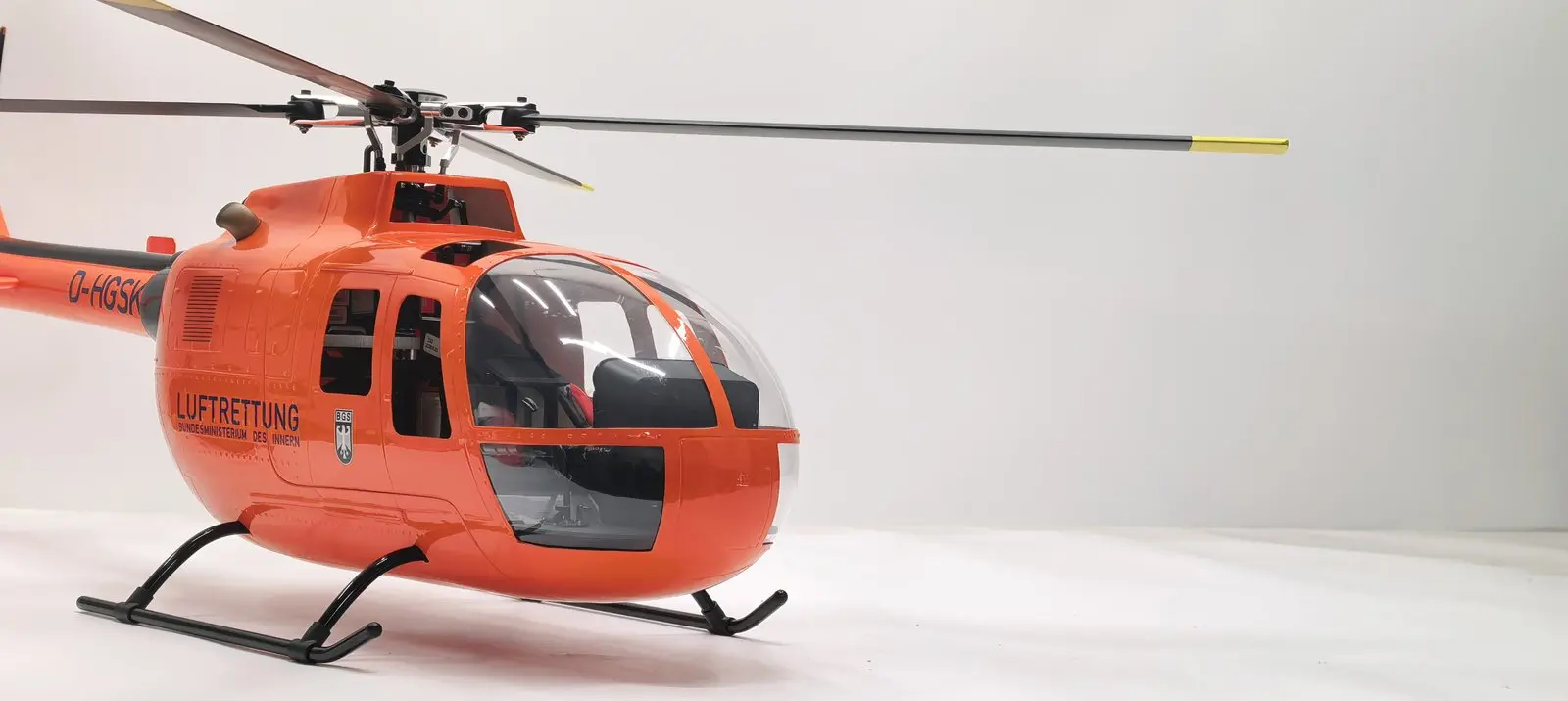
FLISHRC BO105 in orange reviewed: the air-ambulance that flies itself into a hover
The MBB Bölkow Orange 'Luftrettung' livery on the 500-class FL500 V2 platform. Four-blade scale head, GPS-locked hover, £1,600 — and the prettiest of the BO105 range. Here is how it flies.
10 min readGoosky S2 reviewed: the 200-class that grew up
Bigger, calmer and more capable than the S1 that made Goosky's name. After a season of flying, here is whether the S2 is the right first collective-pitch for a UK club pilot.
9 min read