FLISHRC BO105 in orange reviewed: the air-ambulance that flies itself into a hover
The MBB Bölkow Orange 'Luftrettung' livery on the 500-class FL500 V2 platform. Four-blade scale head, GPS-locked hover, £1,600 — and the prettiest of the BO105 range. Here is how it flies.
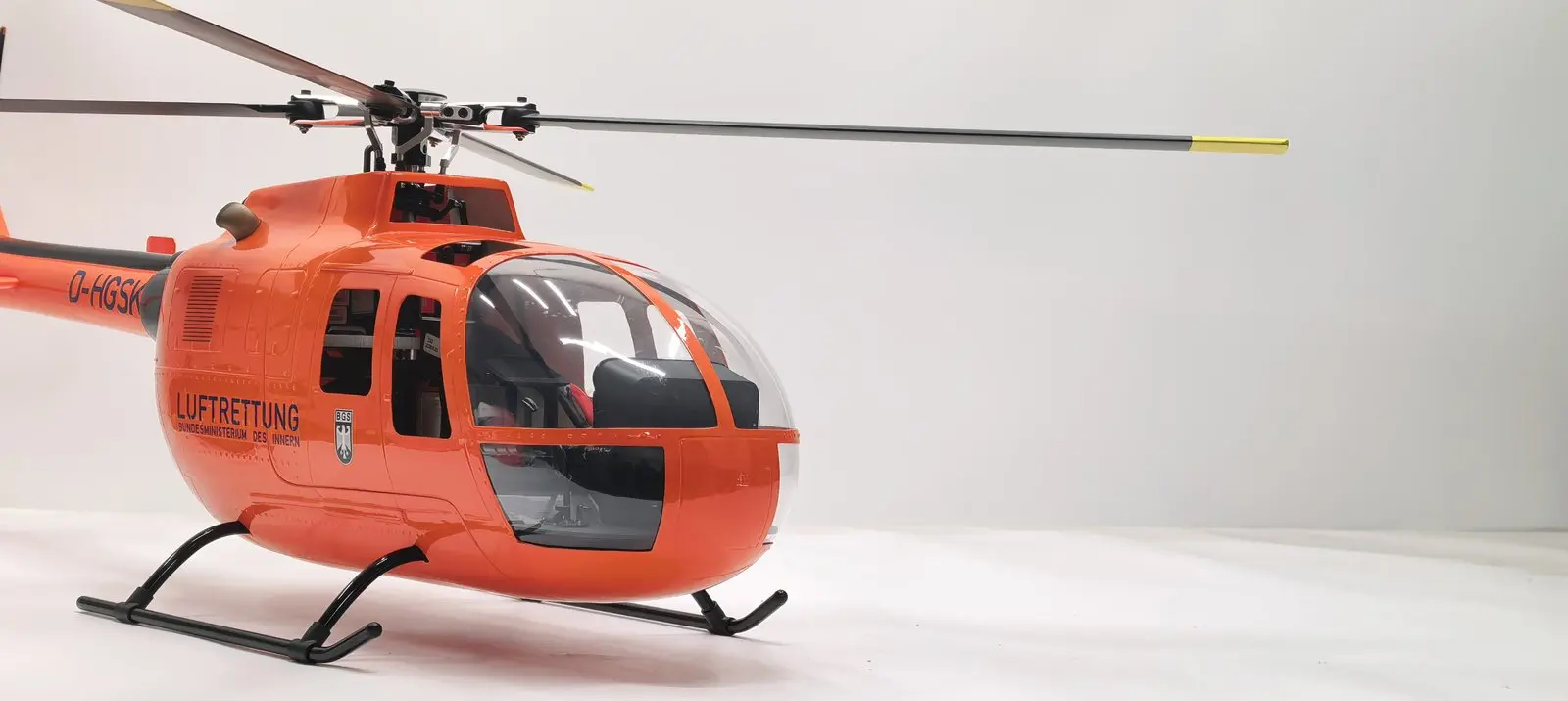
The FLISHRC BO105 is the civilian half of the FL500 V2 scale range — the light-utility, air-ambulance, police-and-rescue side of a catalogue that otherwise leans military. Of its liveries, the MBB Bölkow Orange is the one that stops people at the flight line. It reproduces the German Bundesgrenzschutz "Luftrettung" air-rescue scheme — high-visibility orange over white, registration D-HGSK — on a four-blade 500-class scale platform that a GPS flight controller makes flyable by any competent collective-pitch pilot. We have flown it. Here is the honest report.
If you have not met the platform underneath it, read our FL500 V2 platform review first — this article is about what the BO105 airframe and the orange livery add on top. And note the distinction up front: this is not the Flywing BO-105 we reviewed earlier. That is a 450-class body on generic mechanics at around £650. This is a full 500-class scale machine at just over £1,600. Same real-world aircraft, very different products.
The specs
- Class: 500-class scale
- Real aircraft: MBB BO105 light twin utility, in Bundesgrenzschutz "Luftrettung" air-rescue livery (reg D-HGSK)
- Body: fibreglass, hand-painted (not stickered), with cockpit interior detail
- Size (L × W × H): 990 × 170 × 280 mm
- Rotor: 4-blade main head
- Motors: FLISHRC brushless main; independent direct-drive brushless tail
- ESC: FLISHRC 85A brushless
- Servos: 3 × FLISHRC FL390HV digital swashplate servos
- Flight controller: FLISHRC L7 with GPS (quad-mode BeiDou + GPS + Galileo + QZSS)
- Battery: 4500mAh 6S 60C LiPo (included)
- Radio: FlySky, Mode 2 as standard (Mode 1 on request), pre-bound and factory test-flown
- Build state: RTF
- Price: £1,601.14
Out of the box
The RTF arrives boxed on a moulded tray with the machine essentially complete. Final assembly is genuinely minimal: slide the chassis into the canopy, fit the horizontal stabiliser, attach the decorative parts, tighten a handful of screws. The transmitter comes pre-bound and the helicopter is test-flown at the factory before it ships, so you are charging the pack and heading to the field within the hour rather than spending an evening at the bench.
The fibreglass shell is the point of the whole thing, and it delivers. The orange is properly sprayed, not decalled, and the panel work, glazing and cockpit interior all read as a real BO105 rather than a sport machine wearing a costume. The four-blade head sits right for the airframe — a two-blade sport head on a BO105 body always looks wrong at distance, and FLISHRC have not cut that corner.
One honest caveat on availability: this livery is a made-to-order / special-order item. It shows in stock, but it is built to the order rather than pulled off a shelf, so treat the lead time as weeks, not next-day. If you need a scale heli in your hands this weekend, that is worth knowing before you check out.
The L7 flight controller
The L7 is what turns a heavy, wind-catching fibreglass fuselage into something a mortal can fly. It runs three modes you actually switch between:
- GPS self-stabilising — locks the helicopter in 3D position with no stick input. Let go and it holds. This is what makes the BO105 approachable
- ATT (attitude-assisted) — self-levelling help without full GPS lock, the sensible middle setting for intermediate pilots building confidence
- 6G manual — full manual for experienced pilots who want to fly the scale mission properly
On top of that: one-click return-to-home, failsafe RTH on signal loss, low-battery RTH, and Bluetooth tuning from a phone app so you can adjust gains and limits without a laptop at the field. The quad-mode satellite positioning (four constellations rather than GPS alone) gives faster lock and steadier hold — genuinely useful when you are flying at distance or in tree-shadow where a single-system controller starts to wander.
In practice the GPS mode is the safety net and the 6G mode is where scale flying lives. You take off in GPS hold, settle your nerves, then flick to 6G for the slow orbits and rescue-profile passes that a BO105 is built to fly, dropping back to GPS hold if the wind or your confidence gets ahead of you.
How it flies
The BO105 is one of the lighter, more civilised airframes in the FL500 range, and it shows. On the included 4500mAh 6S pack you get roughly 8 to 9 minutes of mixed flying — noticeably longer than the heavier military fuselages (Apache, BlackHawk) in the same range, which is exactly what you would expect from a lighter light-utility shell.
In the air it does the thing scale pilots buy these machines for: at cruise the fuselage settles and it stops looking like an RC helicopter and starts looking like a small helicopter a long way away. The four-blade head gives it a smoother, more planted disc than a two-blade sport machine, and the air-rescue livery flatters slow, deliberate flying — banked orbits, a low pass down the strip, a gentle approach to a hover as if it were setting down at an incident. It is not a 3D machine and the fuselage was never designed for negative pitch; anyone expecting loops and inverted flight is buying the wrong helicopter entirely.
The tail — an independent direct-drive brushless unit rather than a torque-tube or belt off the main motor — holds well and sidesteps the tail-wag-at-transition complaint that dogged older scale platforms. As with any new machine, check blade tracking before the first flight; see tracking your blades if the disc is not clean.
Why the orange costs more than the other BO105s
The yellow and the red/blue/white BO105 liveries sit at around £1,445; the MBB Bölkow Orange is £1,601 — the dearest of the BO105 line and priced above several other airframes in the range. The difference is the paint. The Luftrettung scheme is a more involved multi-colour high-visibility job with the D-HGSK registration and rescue markings reproduced faithfully, and hand-painted complexity is exactly what moves price across the FL500 catalogue (the same reason the camouflaged Cobra tops the range). You are paying for the finish, not for any mechanical difference — the chassis, L7 and drivetrain are common across the BO105 liveries.
Whether that ~£155 premium over the yellow is worth it is purely aesthetic. If the air-ambulance orange is the one you would put on the shelf, pay it. If you just want a BO105 to fly, the yellow saves you the price of two LiPos.
What to budget beyond the box
The RTF is genuinely complete — airframe, transmitter, a 6S pack and a charger all included — but a 500-class scale machine is not a one-battery hobby:
- More packs. One 4500mAh 6S pack is 8–9 minutes of flying. Buy three or four more for a real session; FLISHRC's own 6S packs are the safe match. See choosing LiPo batteries
- A proper 6S charger if you want to turn packs around at the field rather than one-at-a-time on the included unit
- Spares — a canopy, a main blade set, the odd servo. Scale fuselages cost more to repair than sport canopies, so a gentle first season pays off
- Somewhere legal to fly it. At nearly a metre long this is firmly club territory — you will want BMFA membership for the insurance and Article 16 cover, and a club field rather than a park. Our guide on where to fly has the full picture
Who it is for
The FLISHRC BO105 in orange is the right helicopter for a competent collective-pitch pilot who wants a civilian scale machine that looks magnificent and flies gently — someone drawn to air-rescue and utility aircraft rather than gunships, who will fly slow scale profiles at a club and enjoy the machine on its stand as much as in the air. The GPS L7 makes it accessible enough that you do not need to be an expert; you need to be able to land a smaller helicopter without writing it off.
It is not a first helicopter — £1,600 is the wrong place to learn to hover; start on something small and cheap from our under-£150 shortlist and read how to fly your first hover first. It is not a 3D machine. And if you want the same aircraft for less and can live without the fibreglass and the four-blade head, the Flywing BO-105 does a creditable scale impression at under half the price.
Verdict
The FLISHRC BO105 in MBB Bölkow Orange is the most eye-catching civilian machine in the FL500 V2 range and one of the prettiest scale helicopters you can buy ready-to-fly in the UK. The four-blade head, hand-painted air-rescue livery and cockpit detail make it look right; the L7 GPS controller makes it fly right for a pilot who is competent but not expert. It is priced at the top of the BO105 line purely for that finish, and if the orange is the one that speaks to you, it earns the premium.
For the broader scale picture — classes, what to look for, and how UK distribution finally caught up — see our scale RC helicopters buyer's guide. For this specific machine, in this specific colour: recommended, for the right pilot, with clear eyes about the made-to-order lead time and the club-field commitment it asks of you.
Featured in this article
All helicopters →Keep reading · Reviews
The best scale RC helicopters under £1,000 (2026)
You don't need to spend four figures for a genuine scale helicopter. Here are the best ready-to-fly scale ships under £1,000 — from £449 Flywings to Roban's 450-class RTF range.
Goosky S2 reviewed: the 200-class that grew up
Bigger, calmer and more capable than the S1 that made Goosky's name. After a season of flying, here is whether the S2 is the right first collective-pitch for a UK club pilot.
Best RC helicopters under £150: beginner shortlist 2026
Coaxials, small fixed-pitch trainers, and one collective-pitch surprise. Six helicopters under £150 that are actually worth buying as a first machine.