Scale RC helicopters: a UK buyer's guide
Fibreglass fuselages, GPS-stabilised heads, £1,400 price tags. The UK scale-helicopter scene quietly grew up — here is how to pick one that doesn't disappoint.
- Section
- Scene
- Published
- 2026-05-23
- Read time
- 11 min
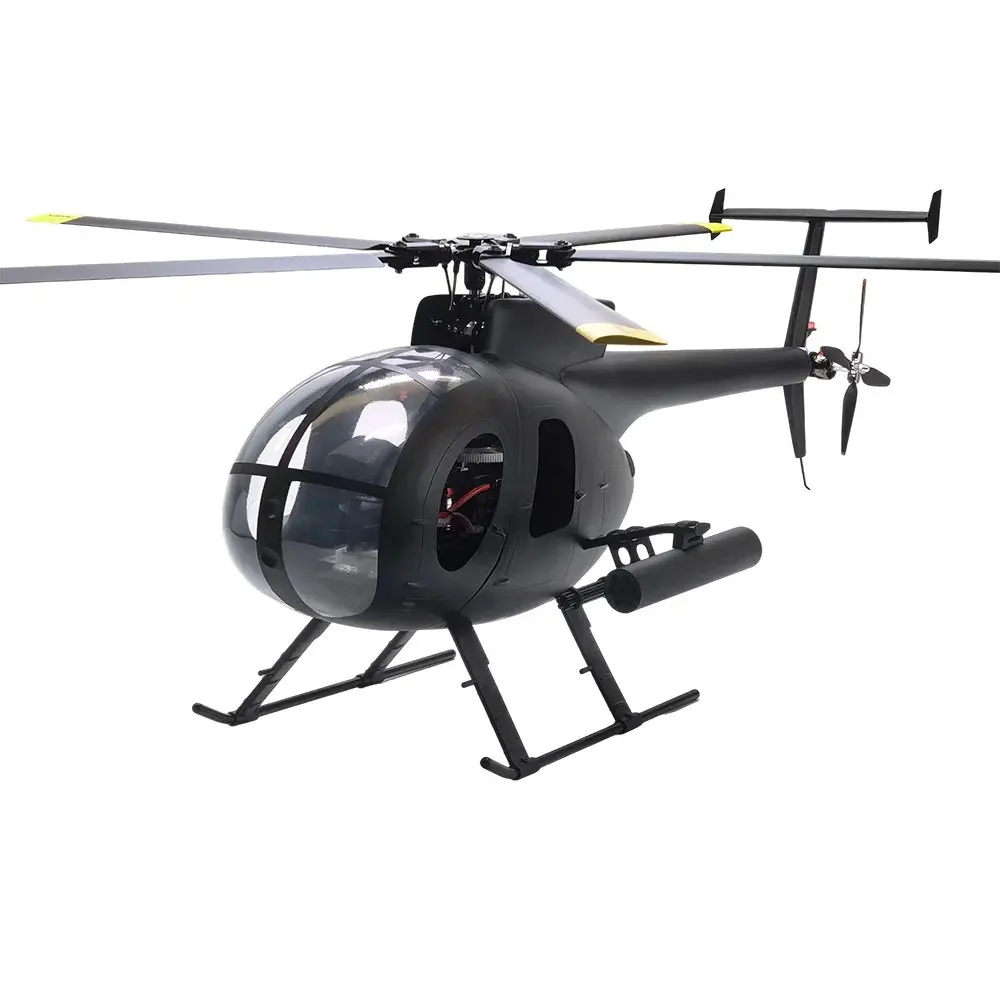
There is a part of the RC helicopter hobby that almost nobody outside it knows about. Walk past a club field on a quiet Sunday and you will see the usual collective-pitch machines hovering and looping — black-and-yellow Goosky S2s, Align T-REX 470s, the occasional 700 doing serious 3D. And then, parked on a folding table at the edge, you will see something completely different. A foot-and-a-half-long Cobra gunship in olive drab, exhaust pipes weathered, a tiny pilot figure in the cockpit, rotor blades hand-painted at the tips. Someone is about to fly it. It will not loop. It will not roll. It will hover into the wind, drift sideways across the field at a realistic scale speed, bank into a slow orbit of an imaginary target, and land on its skids on the grass with the gentleness of the real thing settling onto a carrier deck.
This is scale flying. And in the UK, in 2026, it has become a much more accessible — and much more interesting — branch of the hobby than it was even three years ago.
What "scale" actually means
A scale helicopter is one built to look and fly like a specific full-size helicopter. Not "looks vaguely like a Huey" — looks exactly like a Huey. The fuselage is moulded in fibreglass to match a specific airframe and livery. The rotor head and tail boom are sized to the same proportions as the real thing. The paint scheme is reproduced down to the squadron markings. Good scale models even reproduce the engine and exhaust note — quad-bladed scale heads pull air differently from sport two-bladed heads, and the sound difference is part of the appeal.
There are two distinct things people mean when they say "scale". The first is scale appearance: a fibreglass fuselage bolted onto a generic mechanical chassis. You can buy a 450-class Bell 222 or BO-105 body kit and drop your existing mechanics inside it. The second is scale platform: a helicopter designed from the rotor head down to fly the way the real aircraft flies, with the correct head speed range, the correct tail-rotor authority, GPS stabilisation tuned for slow scale orbits, and matching rotor blade profiles. Different markets, different price points, different pilot expectations.
The three classes you will see
450-class is the entry point. Roughly a metre across rotor-to-rotor, 3S battery, sub-£500 territory once you have a transmitter. The 450 is the sport-class workhorse of the hobby and scale bodies are widely available for it — Flywing's BO-105 is the obvious example, sitting on standard 450 mechanics. You can build a 450 scale heli for under £600 if you already own a transmitter.
500-class is the sweet spot for serious scale work. About 1.1 metres rotor-to-rotor, 6S battery, the size and weight needed for a fibreglass scale body to feel right in the air. This is the segment that has changed the most in the last three years — FLISHRC's FL500 V2 platform has made 500-class scale flying available as ready-to-fly machines at a price that used to buy you a chassis kit and nothing else. £1,200 to £2,000 for a complete RTF aircraft with GPS-stabilised flight controller and matching scale livery.
700-class and larger is where the scale hobby has always lived for serious modellers. A 700 with a proper fibreglass Apache or BlackHawk fuselage will weigh seven kilograms, run on a 12S pack, and cost north of £4,000 before you have flown it. These are the machines you see at the bigger UK scale events. They are spectacular. They are also a serious commitment in transport, charging, and the consequences of a hard landing.
For a first scale helicopter the right answer in 2026 is almost always 500-class. Big enough to look right. Small enough to fly without a flatbed truck. Cheap enough to crash without ruining your year.
What changed: GPS-stabilised flight controllers
For a long time, scale flying meant flying a heavy, draggy, slightly under-powered helicopter on a flybarless unit that was designed for sport models. The pilot had to know what they were doing. A new pilot trying to hover a fibreglass Cobra on a stock 450-class FBL would discover, quickly, that the wind catches the fuselage and the FBL has nothing to say about it.
The GPS-stabilised flight controller changed this. A unit like FLISHRC's L7 — quad-mode satellite stack across BeiDou, GPS, Galileo and QZSS — can hold the aircraft in 3D position against wind, return it to home on a low-battery trigger, and stabilise it in a self-righting mode that a complete beginner can handle. The fuselage still catches the wind. The flight controller now actively corrects for it.
This matters more than it sounds. It means a pilot with a year of collective-pitch experience can fly a 500-class scale helicopter on day one. It means a low-time pilot can take a £1,400 aircraft to a club field without writing it off in the first session. It is the single development that has opened scale flying to a much wider audience than it had before.
What to look for
Fuselage construction. Fibreglass with a proper paint scheme — not stickers — is the baseline for any scale model worth buying. Check for properly-recessed rivets and panel lines, scale-correct window glazing, and a moulded interior with a pilot figure. The cheap end of the market substitutes printed decals for paint and unfinished plastic for the cockpit interior. The aircraft will fly the same; it will not look the same in your photographs.
The rotor head. A scale head should match the real aircraft's blade count and configuration. A Huey runs two blades. An AH-64 Apache runs four. An EC135 runs four with the distinctive Fenestron tail. Get this wrong and the silhouette is broken — most of the visual impact of scale flying comes from the rotor disc looking right at distance.
Pre-tuned vs DIY. Scale platforms now arrive either as RTF (ready-to-fly with transmitter), BNF (bind-and-fly, you supply the transmitter), or as a parts kit. RTF is the right answer for a first scale machine. The pitch curve, the head speed, the GPS gains and the failsafe behaviour are all pre-tuned by the manufacturer for the specific airframe. You bind, you charge, you fly. If you enjoy the building side, kits are still available — but build hours on a scale machine are measured in tens, not hours.
LiPo configuration and shipping. 500-class scale helicopters run 6S 4000–4500mAh packs. These ship UK ground only — no air freight — which matters if you are ordering from Europe. Buy from a UK distributor and you get your aircraft within a week; order direct from the factory in China and you wait two months while the LiPo crosses the world by sea.
The state of UK distribution
Three years ago, getting hold of a 500-class scale helicopter in the UK meant ordering parts from a US specialist, importing the fuselage from Europe, sourcing the head and tail boom from a Chinese supplier, and waiting six to eight weeks for the LiPos to arrive separately by surface freight. Today, the UK distributor model works for scale.
FLISHRC's full 500-class range — Apache, Cobra, BlackHawk, JayHawk, SeaHawk, EC135 in police-blue and EMS liveries, MD500D and MD500E in multiple paint schemes, A109 Coast Guard, BO105, AS350 Squirrel, AH-6 Little Bird, UH-1 Huey, UH-1N Twin Huey — is stocked in the UK with LiPos held in country. Orders ship by UK courier, support is in English, replacement parts arrive within days rather than months. This is the single largest practical change for UK scale pilots in the last decade.
Align still occupies the higher end — the T-REX 700 scale fuselages and their bespoke supporting hardware — and a handful of European specialists keep the 700-and-up market supplied with imported fuselages. But for the £1,200 to £2,000 segment where most pilots actually buy, UK-held stock is now the norm.
Choosing your first scale machine
Two questions decide it.
Which aircraft do you actually like? Scale flying is fundamentally an aesthetic hobby. You will look at this helicopter on its stand more often than you will fly it. Pick the airframe you find genuinely beautiful. The MD500D in matte yellow with the black panels reads completely different from the AH-1 Cobra in olive camo — buy the one you would put on your shelf if it never flew.
What does the club field look like? A Coast Guard A109 or a JayHawk SAR helicopter looks at home over water; if your club flies on a coastal field these models are magnificent in the right light. A military airframe — Apache, Cobra, BlackHawk — sits naturally over open grass. A civilian EMS EC135 or AS350 looks correct in a busier environment with mixed scenery. The aircraft you fly should match the airspace you fly it in.
For a first scale model that hovers gently, looks magnificent, and forgives a new pilot, the AH-6 Little Bird at the lower end of the FL500 V2 range — fewer panels to repaint after a hard landing, a more permissive flight envelope than the heavier military airframes, and a price point closer to £1,400 than £1,900 — is the obvious starting point. It is also one of the rare scale aircraft that flies aggressively enough to do realistic mission profiles: fast forward flight, banked orbits, low-altitude approaches.
What it actually costs to fly
The aircraft is the headline number. The hidden costs are the ones nobody warns you about.
Batteries. A 500-class on 6S 4500mAh will give you 6–8 minutes of mixed flying per pack. You want four packs minimum. £40–£60 each. Budget £200 for a usable pack rotation.
Transmitter. If you do not own one, a Radiomaster TX16S or a Spektrum NX6/NX8 will cover any modern receiver. £180–£400. Buy once, fly everything.
Charger. A 6S-capable parallel charger that can do four packs at once. £150 for a decent one. Less is false economy at the field.
Spares. Main blades, tail blades, a tail boom, a canopy, a set of skids. £80–£120. You will need at least one of these in the first six months.
Field kit. A LiPo bag, a glow plug for the case you brought a nitro friend along, a folding table, a wind sock, and a way to start the rotors gently without spinning a finger into them. £40–£80.
Total realistic cost of owning a 500-class scale helicopter for the first year: aircraft + £500 to £700.
Where to fly
A 500-class scale helicopter is not an indoor machine. You need a club field, BMFA membership, and at least one experienced pilot nearby for your first few flights. The scale community is small, friendly, and visible — most UK clubs have one or two pilots who fly scale and they are universally happy to spend an afternoon helping a new pilot through their first scale hover. Find them. Ask them what they wish they had known. The answer to that question is worth more than any internet research.
The verdict, if you want one
Scale helicopters used to be a hobby within the hobby. A niche of a niche, for pilots with deep pockets, garage workshops, and the time to source parts from three continents. That is no longer the case. The combination of GPS-stabilised flight controllers, UK-held stock of complete RTF aircraft, and a scale fleet that covers every major real-world airframe means a competent collective-pitch pilot can be flying a 500-class scale helicopter at their club field within a fortnight of deciding to start.
It is not a cheap branch of the hobby. It is also not a cheap branch of the hobby for a reason — there is nothing else in radio control that looks quite like a fibreglass Apache settling onto its skids at the end of a slow scale orbit. If you want that, you can have it. The buy-in is lower than it has ever been.
More scene
Where to fly an RC helicopter in the UK
Garden, park, club field, BMFA-affiliated site — what is legal, what is sensible, and what to do before you take the rotors out of the box.
9 min readBMFA membership: what it is, what it costs, why you need it
Insurance, Article 16 authorisation, club access, training. Why the £40 annual fee is the single best money you will spend on the hobby.
7 min readThe state of UK RC helicopter clubs in 2026
Membership is up, scale flying is back, and the £30 club fee is the best-value access to a runway in the country. Where the UK heli scene actually sits.
8 min read