RC helicopter terminology: a glossary for total beginners
Pitch, gyro, swashplate, FBL, head speed, collective, cyclic — what every term means, in plain English, with no assumed prior knowledge.
- Section
- Beginners
- Published
- 2026-05-05
- Read time
- 8 min
RC helicopter discussions are dense with jargon. Every product page assumes you know what a swashplate is. Every YouTube tutorial assumes you know the difference between collective and cyclic. This glossary explains the terms a new pilot will actually encounter, in plain English, with no prior knowledge required.
The aircraft itself
Main rotor — the big spinning disc on top. Generates lift.
Tail rotor — the small spinning disc on the tail boom. Counteracts the main rotor's torque so the helicopter does not spin uncontrollably. Some advanced helis use a "Fenestron" (ducted fan) instead of an exposed tail rotor.
Head — the assembly at the top of the main shaft that connects the rotor blades to the helicopter and lets them change angle. The most mechanically complex part of any heli.
Boom — the long tube that connects the main body to the tail rotor. Usually aluminium or carbon fibre.
Frame — the structural skeleton of the helicopter, usually carbon or plastic, that everything else bolts to.
Skids — the landing gear. Designed to be sacrificial — they bend or break in a hard landing to absorb impact and save the frame.
Canopy — the plastic or fibreglass body cover. Cosmetic on sport helis, scale-accurate on scale models.
Fuselage — the full body of a scale helicopter, replicating the real aircraft. Distinct from a sport canopy in that it covers more of the airframe and is shaped to match a real-world helicopter.
The mechanics
Pitch — the angle of the rotor blades relative to the air. Higher pitch = more lift. Pitch can be positive (blades angled to lift the helicopter up) or negative (blades angled to push down, used for inverted flight).
Collective pitch — when all main rotor blades change angle together at the same time. Pulling up on the throttle/collective stick raises every blade's angle simultaneously, generating more lift and climbing the helicopter.
Cyclic pitch — when blades change angle individually as they rotate, so a blade on one side of the helicopter has a different angle than the blade on the other side. This tilts the rotor disc and makes the helicopter move forward, backward, or sideways.
Fixed pitch — a simpler rotor head where blades cannot change angle. Climb is controlled only by rotor speed. Found on cheaper beginner helicopters and toy-class models.
Swashplate — the mechanical link between the non-rotating controls (servos) and the rotating rotor head. Translates servo movement into pitch changes on the blades. Two halves: a stationary lower half and a spinning upper half.
Headspeed — how fast the main rotor spins, measured in RPM. A typical 450 hovers at around 2,400 RPM; a 700 3D machine spins up to 2,800+ RPM.
Autorotation — the technique of landing safely after motor failure by using the helicopter's downward momentum to keep the rotor spinning. Advanced manoeuvre, foundational survival skill.
The electronics
ESC — Electronic Speed Controller. Takes the battery voltage and tells the motor how fast to spin. Sits between the battery and the motor.
Brushless motor — the type of electric motor used in almost every modern RC helicopter. More efficient and longer-lived than older brushed motors.
Servo — a small electric actuator that moves a control linkage. Helicopters typically have three cyclic servos and one tail servo.
Receiver — the radio module on the helicopter that listens for signals from your transmitter. Various brands and protocols: Spektrum DSMX, FrSky, Futaba, FlySky, etc.
Transmitter — the handheld radio you fly with. Sometimes called "TX" or just "radio".
Gyro — a sensor that measures rotation. Used to keep the tail steady. Modern helicopters use multi-axis gyros that stabilise all three axes.
Flight controller — the brain of the helicopter. Reads the gyros and the receiver inputs, decides what each servo should do, and sends the commands. Often abbreviated as FC or FBL (see below).
FBL — Flybarless. Almost all modern collective-pitch helicopters are flybarless, meaning they use an electronic flight controller in place of the mechanical "flybar" that older helicopters used. Common FBL units: Brain 2, MicroBeast, IKON, FLISHRC L7.
GPS hold — a feature on advanced flight controllers that uses satellite positioning to lock the helicopter in 3D space, holding it against wind. Standard on most modern scale platforms.
RTH — Return-To-Home. A flight controller feature that, when triggered (by low battery, signal loss, or pilot command), automatically returns the helicopter to its takeoff point.
The battery
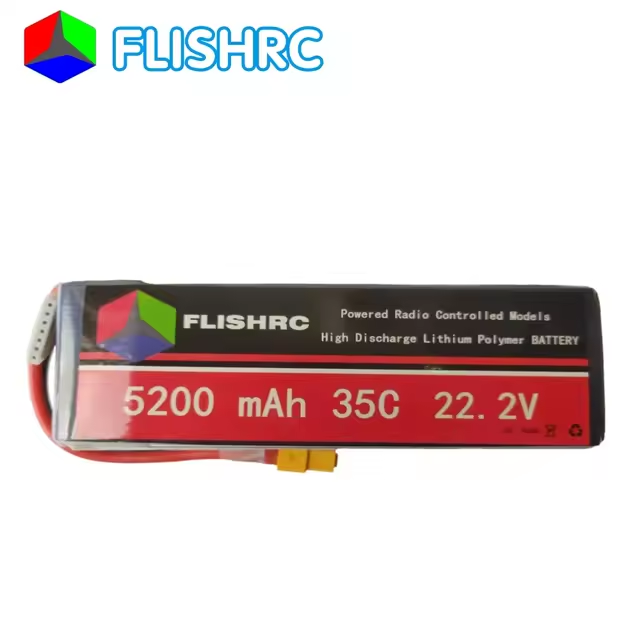
LiPo — Lithium Polymer. The battery chemistry used in almost all modern electric RC helicopters. See our LiPo guide for detail on selection and care.
S — cell count, written as 3S, 6S, 12S. Each cell is nominally 3.7V; 6S = 22.2V nominal.
mAh — capacity (milliamp-hours). Larger number = longer flight time and more weight.
C rating — discharge rate. A 45C 2200mAh pack can theoretically deliver 99A continuously.
Connector — the plug on the battery. Common types: XT60, XT90, EC3, EC5.
Balance lead — the smaller secondary plug on a LiPo, used by a charger to balance the voltage of individual cells.
The flight
Hover — holding the helicopter stationary in the air. The foundation skill.
Tail-in / nose-in / side-on — orientations of the helicopter relative to you. Tail-in is easiest, nose-in is hardest.
Forward flight — flying the helicopter in a chosen direction across the field. Easier than hovering once you can fly through it.
3D — aerobatic manoeuvres using both positive and negative pitch: loops, rolls, inverted flight, tic-tocs, piro flips. Requires a collective-pitch machine and skilled stick work.
Scale flying — flying a helicopter designed to look and fly like a specific real-world aircraft. Distinct from 3D and from sport flying. See our scale buyer's guide.
Bind — the process of pairing the transmitter to the receiver on the helicopter. Usually done once, when you first set up the aircraft.
Failsafe — the pre-programmed behaviour of the helicopter if the radio signal is lost. Should always be set to "throttle hold" so the rotors stop rather than spin up uncontrolled.
The hobby infrastructure
BMFA — British Model Flying Association. National governing body for model aircraft in the UK. See BMFA membership: what it is.
Article 16 — the CAA's authorisation framework that lets BMFA members fly model aircraft under more permissive rules than the standard "open category" drone rules.
A Certificate — the BMFA's entry-level pilot competency test, demonstrating safe solo flight. Most clubs require it before you can fly without supervision.
B Certificate — the BMFA's advanced pilot competency test, demonstrating more complex flight including aerobatics and emergency handling.
Operator ID — your CAA registration as the responsible person for one or more aircraft. Required by law for any aircraft over 250g.
Flyer ID — your CAA registration as someone qualified to fly an aircraft over 250g, earned by passing a short online theory test.
When in doubt
If you encounter a term not in this glossary, two reliable sources: the BMFA helicopter handbook and the RCGroups helicopter forum, where almost every term has been explained by someone, somewhere, with infinite patience for new pilots.
Kit to build what you just read
More beginners
RC helicopter classes and sizes explained: 150 to 800
150, 450, 500, 700, 800 — RC helicopters are sized by class, and the number tells you the rotor size, the power, the skill needed and where you can fly. Here's the whole ladder.
8 min readHow to fly an RC helicopter: your first hover, step by step
Sticks, trims, throttle hold, the tail-in hover. The exact sequence that gets a total beginner off the ground safely — and the three mistakes that break blades in the first session.
9 min readRC helicopter vs drone: which should you actually buy?
One hovers itself and shoots 4K video; the other demands months of practice and rewards it forever. An honest comparison of what each is really for — and which suits you.
8 min read