RC helicopter gyros and governors explained
Two systems keep a helicopter pointing straight and spinning at a constant speed: the tail gyro and the governor. Here's what each does, and how to spot when one needs adjusting.
Two electronic systems work quietly in the background of every good helicopter flight: the tail gyro, which keeps the nose pointing where you left it, and the governor, which holds the rotor at a constant speed. On modern machines both are built into the flight controller, but knowing what each does — and what it looks like when one is misbehaving — makes you a much better troubleshooter.
The tail gyro: keeping the nose straight
A single main rotor produces torque, which tries to spin the whole helicopter the opposite way. The tail rotor counteracts that torque, but the amount of correction needed changes constantly with power and wind. The tail gyro is the electronics that manage this: it senses any unwanted yaw and adjusts the tail-rotor pitch to cancel it, far faster than a human thumb could.
Modern gyros run in heading-hold (also called AVCS) mode: they don't just damp the rotation, they actively hold a heading, correcting back to where the nose was pointing. The older rate mode only slows the rotation without holding a heading, and is rarely used now.
You'll know the gyro's tuning is off from how the tail behaves:
- Tail wag — a rhythmic side-to-side hunting of the nose — usually means gain is set too high
- Tail drift — the nose slowly creeping round on its own — usually means gain too low
Our tail wag, drift and bobbing primer walks through diagnosing these in detail.
The governor: holding constant headspeed
A helicopter flies best when the main rotor turns at a constant speed, regardless of what the collective pitch is doing. Without help, adding pitch loads the rotor and slows it down; reducing pitch lets it speed up. The governor prevents this by continuously modulating power — throttle on a nitro machine, or motor output on an electric one — to hold a target headspeed.
The payoff is consistency. With a governor holding headspeed, the helicopter responds the same way to the same input every time, whether you're hovering gently or pulling hard collective. It also makes the machine feel planted and predictable, which matters most on the scale ships we stock, where smooth, consistent flight is the whole point.
On modern helicopters, it's all one box
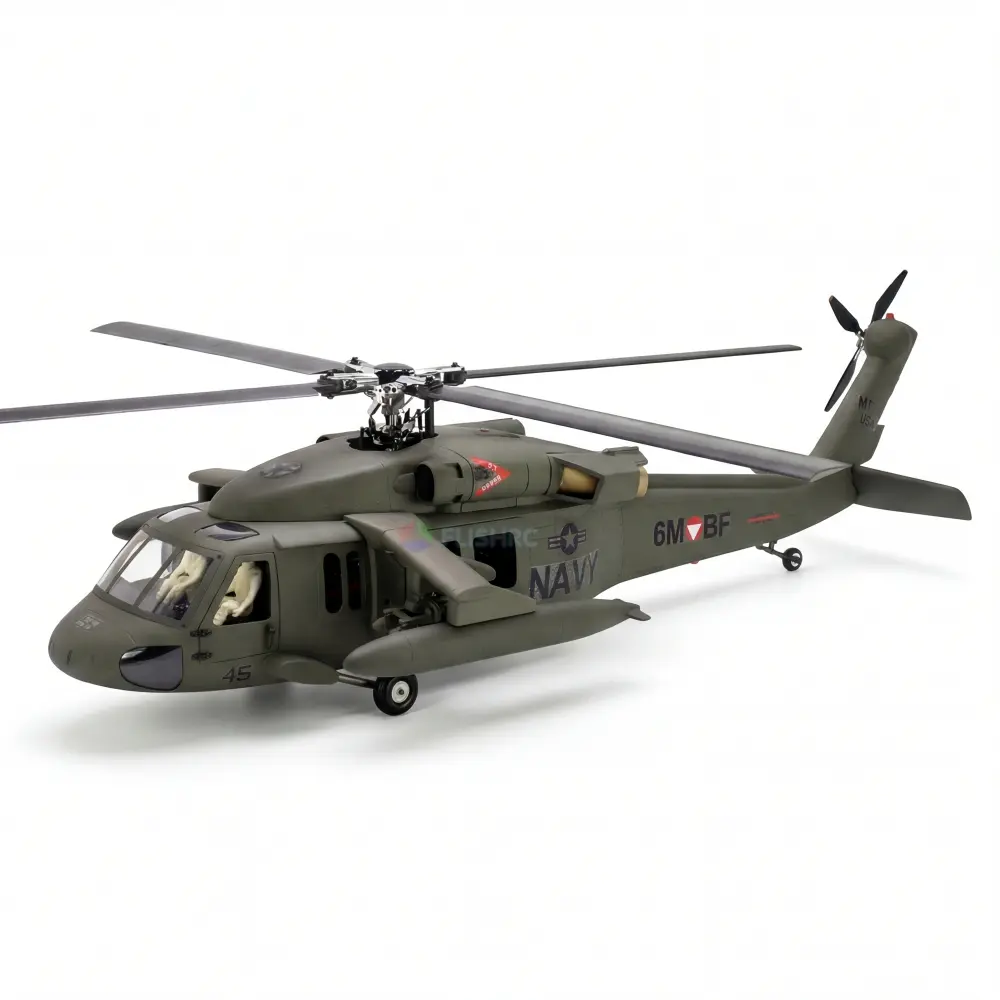
On everything scale we sell, the gyro and governor are part of the integrated flight controller — the FLISHRC L7 on the FL500 V2 range, or the equivalent unit in a Flywing ship. You don't buy or wire them separately; you tune them in software. That's a good thing: it means a steady tail and consistent headspeed come as standard, and adjusting them is a matter of changing a number.
The takeaway
The gyro keeps the nose straight (wag means gain too high, drift means too low); the governor keeps the rotor speed constant so the helicopter always responds the same way. Both live in the modern flight controller alongside the flybarless stabilisation. If your tail hunts or your headspeed sags under load, you're looking at a gyro or governor setting — not a broken part.
Keep reading · Guides
The RC helicopter swashplate explained: CCPM, collective and cyclic
The swashplate is how your control inputs reach the spinning blades. Understand collective, cyclic and CCPM mixing and the whole helicopter suddenly makes sense.
Flybarless (FBL) systems explained: what they do and why every modern heli has one
The spinning paddles are gone. Modern RC helicopters use an electronic flybarless unit instead — a three-axis gyro brain that makes them steadier, more precise and lower-maintenance. Here's how it works.
Flywing vs FLISHRC: which scale RC helicopter should you start with?
Two scale brands, the same fly-it-not-build-it idea — but a £900 gap in price and a real gap in size and detail. Where Flywing's affordable ships end and FLISHRC's premium FL500 V2 range begins.